Tuesday, May 22, 2007

Day Six - Taschi Chil to Dzato

Thursday, 16 May 2007

9.16am - Having dropped the Village Chief Do Ku Jiam Chu off at Say Kay (village community "centre"), we retraced our route east and made for Dzato, which lies about 230km away. The sky was overcast with the sun attempting to break through the heavy clouds. Every now and then, it succeeded in beaming its rays to the vast marsh plains and mountain ranges below.


Trekking towards the morning sun


The white of the frozen river separating brown earth and the grey skies


A chance upon a wolf


Unspoilt marshland at above 4,000m


Careful navigation ensures we get back on proper track


A dry riverbed with the Zanarigen mountain range as backdrop


Highland deers graze in the vast open grassland


Driving to meet the mountains


Blue skies, white clouds, snow capped mountains - the ingredients of Shangri-La


An eagle circles the sky in search for a prey


A river full of "Huang He Luo Li"


At last, the sun wins its battle against the veiling clouds


1.45pm - We arrive at Zaqian town


As there are no restaurants and guesthouses in Zaqian, we made our own lunch


Boiling water in gusty winds is a challenge - better to do it sheltered


Mr Shi demonstrating his outdoor cooking (boiling water) capabilities


2.30pm - On our way again after a nice hot cup of instant coffeem bread with szechuan pickles and oreo biscuits


Uplifted spirits at a high pass


3.50pm - Traffic jam at mid levels


Passers-by lend a helping hand


The trail to get across the mountain range


The bridge across the Dzachu - now a familiar sight


Za Qing Da Qiao


4.10pm - Back at Dzato Town. Two billys scavenging for food


A less lively street in less cheerful weather


The building which housed our Guesthouse and the restaurant which we dined at (Shou Zha Da Wang Fan Dian)

Warmth by a Nomadic stove

Having been to Taschi Chil, the old man who volunteered to come along with us offered to take us in for the night. And for the first time in my life, I experienced the life of a Kham Tibetan nomad. And how timely too! We no longer needed to pitch a tent in the cold, wintery heights (although that would be an adventure in itself not to be missed!)

And so we drove back to where we came from, and making our way around the plain, the old man suddenly instructed for us to make a sharp left. It puzzled me as we were in the middle of no where. I distinctively remember picking him up from a one-storey building.

Driving downslope, I can make out a dirt track - not very evident in the dimming skylight- leading steadily downhill and curving to the right. Ten minutes later, a flat structure rises from the ground. Then it made sense. His house is situated on a lower level than the main dirt track we were on.

We drive slowly along the bumpy mushy ground and passing pens full of yaks and sheep, we arrive at the front of his house, welcomed by his family. We got out of the vehicle and took our things and followed them in through a narrow door.


Once indoors, I could feel the heat coming from the stove-table in the middle of the long room. It was dark except for a white bulb hanging from the low ceiling. I put my backpack on a seat against the wall facing the stove. I was like a moth attracted to light. It's the most amazing feeling to get out of the cold, windy air and to be seated on a cushioned seat, sheltered from the icy winds, and kept warm by the burning stove just inches from my knees.


One of the family members, a man in his thirties, got about and using a spade, dug into a steel bucket by the door, and shovelling its contents into the stove table, then slide the lid back to cover the lapping flames. I thought they were coal and wondered how much it would cost them to buy so much coal. Not to mention where they would buy them from. The nearest town has got to be Dzato, which is easily 200km away. It was not till the next morning that I found out from Pema that the fuel that kept the fire burning the whole evening was dried dung from the Yaks. But I don't remember any smell, not even when burning. How miraculous! And to think people in the town use coal - and how I was choking in my bed from its fumes! We really need to take a leaf out of the nomads where it comes to recycling and going green!


Just as I was warming up, a lady in her fourties reached across the stove to refill my drink. It was a diluted version of the Yak tea and in the cold, it was comforting. She was to continuously refill my paper-cup with the tea, putting more water to boil, and making more tea for the rest of the evening that we sat there chatting (or rather Pema was chatting with them, or interpreting for me). We helped ourselves a large crucible of bread - handmade by the lady of the house, while drinking the tea. Mr Shi took out the left over "man tou" which we placed onto the metal stove to be baked. It worked wonderously as the bread become crispy on the outside while chewy-soft on the inside. Then, Pema asked if I would like to help myself to some Yak meat. I said yes, and Mr Shi helped to carve small slices out from what looked like a part of the leg. The meat was tough, but didn't have a heavy taste or smell. I chewed at it. It was tasty (or I was hungry) but it certainly tasted natural and without any hint of MSG, which was a relief. Some of the meat got stuck to my teeth so I spent a considerable amount of time chewing and picking my teeth in the dark. Pema said that the family consume a total of three yaks in a year - so I must be really lucky to walk in on them while they were having it!


Throughout dinner, I felt the stare of the children who were aged 7, 10 and 13. They were silent throughout the night, eating what they were fed by two adults who must be their parents. When I asked Pema who they were, it was then that we found out that the old man who took us to the source was the village chief (there were 8 families living in close proximity of about 20 km from each other) and that this was the house of his youngest son of six children. The kids were his grandchildren. His other children are living elsewhere.

His name is Do Ku Jiam Chu.

Well, what do you know? First, we came to dead end of a dirt track allegedly bringing us to the source, then we met a nice old man who volunteered to take us there, then we escaped a night out camping in the cold in exchange for warm tibetan hospitality. Then, we discovered the nice old man is the village chief. It keeps getting better, I tell you!

After chatting and finding out more about him, and the source (which was blessed by a holy lama called Za Na Wan Tul), and his family, and sharing more about me and where I came from, it was time for bed. Pema explained that Chief had invited us to stay with his family - inside the bedroom. I was moved by their hospitality and so gladly accepted.


Taking my belongings, I followed the lady into the adjacent room separated by a heavy piece of cloth that was as thick as a blanket. Inside, though there was no heated stove, I could feel the cold being kept out by the sheer amount of blankets and heavy textile covering every inch within the space. Pema and I were assigned the space along the wall to the right, so we slept with our feet pointed at each other. I dug out my sleeping bag and settling myself down, tried to get some sleep. I could hear the rest of the family settling into bed at the other places. Mr Shi decided earlier on that he would sleep in the car as he was used to it.

It was 10.30pm and as we were above 4,000m elevation this time, the headache hit like a jackhammer pounding at my temples. No matter which way I turned, I couldn't find a position that the headache would go away, or feel better. The unfamiliar smell of yak milk was also beginning to get to me and at some stage, I began to feel a sense of panic. It didn't help that I was also coughing badly due to the cold and the entire night was spent coaxing myself to sleep. I needed to rest, but rest was a luxury that eluded me. The last time I checked my watch, it was 6am. It must have been shortly after that I fell asleep.


Opening my eyes again, light was coming through the bedroom window. It was 7.30am. And miraculously, the headache was gone. I got out of bed and noticed that everyone else had gotten up. People of the nomadic culture sleep early and get up earlier still. Mr Shi told me they had been up to release the animals from their pens to set them into the plains to graze. He knew because he was rudely awoken by moving animals about him in the car!

8.00am - we sat around the stove-table again for breakfast: toasted "man-tou" with strawberry jam, Oreo biscuits and 3-in-1 coffee mix (diluted). We chatted somemore and I asked about the various names of the mountains surrounding us. Pema interpretted that where we are is called Yar Ba Sha Na, at about 4,400m elevation. The house that we picked the chief up from the day before is named Say Kay. The plains that we circumvented yesterday to get across to the source on the opposite side is named Ra Ya Gong Nong, which sits at the foot of the Za Na Ri Gen mountain range. I made a quick drawing and took down the tibetan writing (which was mostly guess-work anyway as the chief didn't read nor write Tibetan - so mostly based on phonetics and Pema's grasp of the Tibetan language)
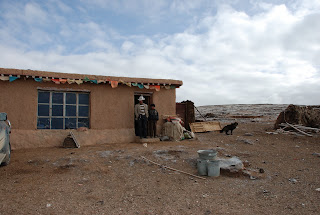


By 8.30am, we began to take our leave from the Chief's residence. We set off earlier because he had requested us to drop him off at Say Kay as he had a meeting at 9am. Before we left, I took the opportunity to take shots of him and his family. We even managed a group photo. I asked Pema to get from him a mailing address so I can send the pictures to them and although I it written down in writing, we really wondered if they will receive the mail. Anyhow, I shall send it and keep my fingers crossed they will receive them. I'm certain they would be delighted to see their photos. It's the least I can do to return the warmth I received at the roof of the world.

Village Chief Do Ku Jiam Chu and family outside their residence at Yar Ba Sha Na


Pens by the side of the house for keeping the Yaks and sheeps at night


Looking west beyond the mud wall lies Tashi Chil across the Ra Ya Gong Nong plains

Monday, May 21, 2007

Day Five - Jyekundo to Tashi Chil

Wednesday, 15 May 2007

8.30am - We got off to a later start this morning. I roll myself out of the sleeping bag into a chilly bedroom. Pema had already woken up and he was making himself a cup of hot coffee. Pouring hot water out of the flask the land lady gave us last night, he made another for me. Whilst packing, I help myself to some Oreo biscuits. We decided to have breakfast in the room because Mr Shi knows that no restaurant would be opened so early. At this point, Mr Shi joins us.

9.00am - We leave the Guesthouse and drove through the waking streets of Dzato.


First stop - to put some air into the tires, then fuel up the four wheeler.


And we're off, going along Ran Zhi Lu, headed steadily west out of Dzato town.


In the distance, the mountains beckon. The sky is overcast whilst the road is dusty. I secretly wish the sun would come out. Soon. If not for the photos, then for the warmth.


9.46am, we cross the Dzachu river via the Zha Qing Da Qiao. We stop briefly to confirm that we were on the right track. There is only one up the mountain and it would be a long way more to find out if we were wrong.


View of the Dzachu - which would flow southwest until it joins with the Ngamchu to form the Mekong River.


The bridge we cross disappearing slowly into the distant morning mist as we make our ascend up the Shi Sham La (Shisham Pass)


We climb slopes up to 45 degree gradient


And it's beginning to snow.


As we follow the dirt track northwards, snow capped mountains rise up to greet us.


10.02am - we arrive at the top of Shisham La. Colourful prayer flags flap in the gusty mountain winds.


Descending, the clouds appear to have heard my prayer and begin to show signs of breaking up.


Snaking down the mountain pass, the sun's rays bake the sides of the mountain.


And surely, the skies are clearing up. Below us, a mushy plain welcomes us.


10.47am - We meet a river as we approach the plain. The green-blue hues of its waters suggests its clarity.


Following the river, we meander through bumpy terrain of gravel and rocks.

10.55am - We arrive at Zaqian, a small village resting by the river.


10.58am - We cross the bridge

And headed west towards another mountain range. Along the way, we circumvented two pillar of solitary rocks that point skywards and then head downhill in a northerly direction. We soon emerge on plain embraced by majestic snow-capped mountains to its west. We are at elevation 4,300m.


11.27H - We pass a river that has its top frozen off


See the thickness of the ice over the river


And how close we had to pass. Wonder what happens in summer when the ice melts? Would this road be passable? We crossed the river at its narrowest and headed north.


11.58am - We descended the range into a valley

And continued to be awed by the view and the changing weather

12.06pm - We arrive at the edge of the plain, then begin to head downslope where we meet a wide riverbank

12.13pm - We crossed the riverbed and emerged on the opposite side. At this point, the road diverges into two tracks

We wanted to be sure so we waited for about 10 minutes before passersby came across the riverbed the same way as us. We stopped one of them to ask which way to the source.

They pointed northwards and said they were headed in the same direction. So we followed.
12.45pm - Mr Shi decided to stop the vehicle to repair the window on Pema's side. I took the opportunity to be shutter-happy

The only flowers that have started blooming in this weather.


River is one feet deep.


Yaks grazing

1.06pm - We cross a small stream

1.16pm - we crossed yet another river and headed westerly. Mr Shi stopped to repair the window again.

While I got acquainted with the rodents that rule and ruin the tibetan plains.

That's a marmot. Or so I was told!

1.41pm - We resume the journey, making our way up the mountain range. Snow and hail begin to fall

2.41pm - We reached the height of the pass and took in the view at the top of the world

See the mountains stretching as far as the eyes can see

2.49pm - We climbed back into the vehicle to continue the trek.

Passing the peaks on both sides.

Until blue skies show up again

Prayers were answered

And we make our descend


Back onto a plain about 4,200m

The road forks. We took the one headed north and then make another left, headed west.


Then crossed a bridge over clear running water and headed towards the snow capped mountains in the distance

3.31pm - stopped to help a vehicle stuck in the midst of a riverbed were crossing. They ran out of petrol. There was nothing we could do.

So we wished them well, and crossed the riverbed

And continued on our journey

When we meet with an obstacle - the river had frozen over our path

3.48pm - Mr Shi and Pema scouted for a way to get across the frozen river

See the extend of the freeze

Our second attempt


Then changing our angle of attack, though risking being stuck in ditches

Skillful driving


3.52pm - We made it!

Leaving the view behind as we continued on the dirt track

4.43pm - Then, another frozen river.


This one a lot worst than the first. We contemplated safety. Mr Shi feels it's a little risky. if we get stuck, we will be alone, hundreds of kilometres from any help. This is the point when everything seems to coming to a dead end. Should I push for it? Or should we turn back? How far can I go? Questions raced through my head. Pema looked around for another way. No other way. We either dash through the ice or we turn back.

Just then, two motorcycles came by. Pema stopped to ask them how far are we from the source. They said about 10km. Damn. This is worse than I thought. Knowing that I am so close yet so far away makes it all the more miserable. Mr Shi and Pema exchanged glances. I willed secretly that they will say yes. We watch as the passersby drive through the ice.

Seeing that they made it through, I asked if Mr Shi was comfortable trying the stunt. He looked back and, not wanting to let me down, said we shall try. And so we did. Pema and I walked across the ice while Mr Shi navigated his way...

5.32pm - We made it across. Thanks to Mr Shi's fantastic driving skills. We now have a jubilant Mr Shi looking back at the distance that we came.

And the mark that he made


The sun came through finally and we headed across yet another frozen river, though less dramatically. View from "Mani" stones by the river gives a sense of awe.

And we continue, closer than before.

6.33pm - Along the way, we cross yet another plain at 4,500m. About 50 wild Tibetan horses graze in the setting sun.

It was a view not to be forgotten.
6.54pm - The road suddenly ends at a deserted house. We retraced our route and come across a nomadic settlement. We stopped to ask for direction. An old man pointed west into the setting sun across the plain and told us the source is there. He even volunteered to come with us. Not wanting to take another chance, we took the man with us and went back the same way. Just prior to the rising slopes, he ordered a sharp turn to the right. We now cross the edge of the plain and headed southwesterly

We climb the slope before arriving at a flat. Here, ponds and small lakes glisten under the evening sun. We are very close.


7.55pm - We finally arrive at the spot where large prayer flags flap gracefully in the wind. Following behind the old man, we climb up towards the flags and low and behold, we've arrived.
Tashi Chil - The Spiritual Source of the Mekong River.

The three adventurers

The source with a frozen core

Prayer flags of the Source


Sending prayers of peace to be carried by the wind all over the world

A closer look at the icy pure core

Prayer flags at sunset
And from here, the river flows
It was a wonderful experience and all of us were elated. Three days on the road - not just the distance, but the dangers of falling over the cliffs or into ditches or frozen rivers - had led us to a spectacular view of the source in the final rays of the Tibetan sun. For that moment, each of us were lost in a quiet peace and a sense of fulfillment. It's as if we've come home.